


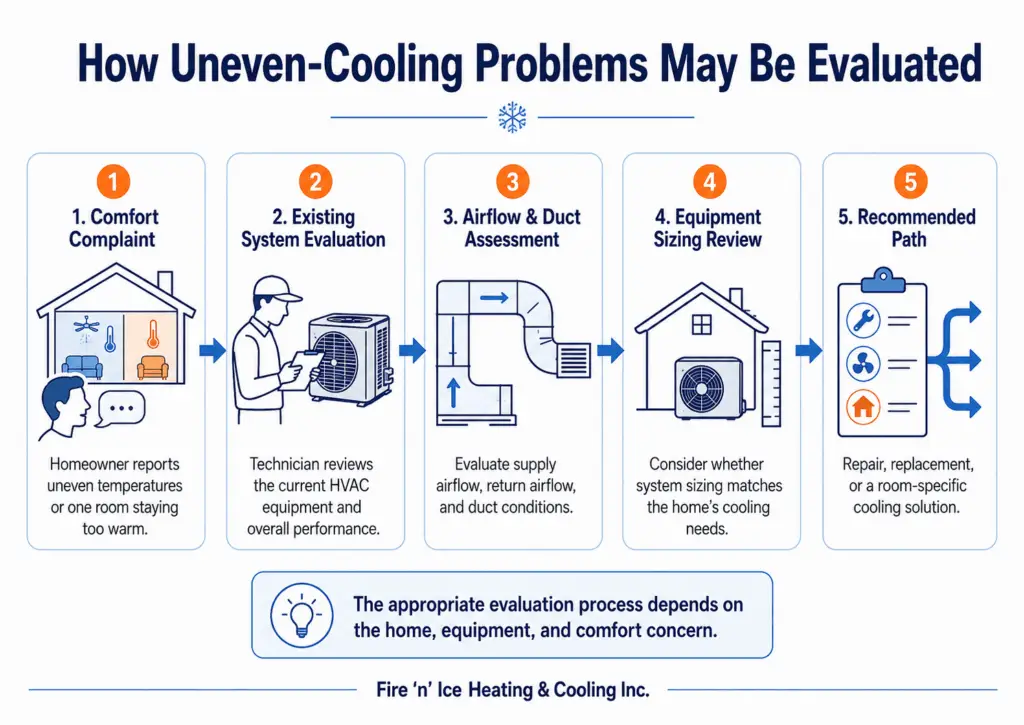
A new air conditioner does not automatically correct every existing comfort problem. Fire ’n’ Ice Heating & Cooling Inc. can evaluate the equipment and the rest of the cooling system to determine what may be contributing to uneven temperatures.
Why Can a New AC Still Cool Unevenly?
An air conditioner works as part of a larger whole-home system.
The outdoor equipment may produce cooling, but that cooling still has to move through the indoor equipment, duct system, supply registers, rooms, and return-air pathways before the thermostat responds.
Comfort can be influenced by:
- AC equipment
- Indoor blower or air handler
- Supply ductwork
- Return-air pathways
- Thermostat location
- Home layout
- Room exposure and heat gain
- Equipment sizing
- Installation setup
That is why uneven cooling should not automatically be blamed on a “bad AC unit.”
The better question is whether the entire cooling system is moving and controlling conditioned air the way the home needs.
AC Installation Problems That Can Affect Comfort
Several installation-related conditions may contribute to uneven cooling. None of these symptoms, by themselves, prove that an installation was performed incorrectly. They are reasons to look at the system more closely.
Incorrect Equipment Sizing
Air-conditioning equipment should be selected based on the cooling needs of the home rather than assuming that a larger unit will perform better.
Proper sizing should account for factors that affect the home’s cooling load. Simply replacing an old unit with equipment of the same nominal size may not answer questions about whether the original system was correctly matched to the house.
A professional sizing assessment may consider characteristics such as:
- Home size and layout
- Insulation and building envelope
- Window area and orientation
- Sun exposure
- Occupancy
- Existing ductwork
- Other factors affecting heat gain
Homeowners should not rely on simple square-footage formulas to size equipment themselves.
Existing Duct Problems Were Not Addressed
Replacing the air conditioner does not automatically correct existing ductwork problems.
If some rooms already received poor airflow before the replacement, those same rooms may remain uncomfortable afterward unless the underlying distribution issue is evaluated.
Potential concerns may include:
- Damaged or poorly performing duct sections
- Restricted airflow
- Existing room-to-room imbalance
- Inadequate return-air pathways
- Duct conditions that do not match the needs of the current system
These issues require professional evaluation.
Homeowners should not cut, resize, seal off, or modify ductwork based on guesswork. Changes to the duct system can affect airflow throughout the home.
Supply and Return Airflow Was Not Evaluated
Cooling equipment cannot provide even comfort if conditioned air is not being delivered and returned effectively.
A central system depends on two related processes:
Supply airflow moves conditioned air into rooms.
Return airflow brings air back to the HVAC equipment to be conditioned again.
If either side of that airflow path is not working as intended, some spaces may receive less effective cooling than others.
A room can therefore feel too warm even when the air conditioner itself is operating.
Thermostat Location Does Not Reflect the Problem Rooms
The thermostat responds to conditions where it is located.
That means the temperature around the thermostat may not always represent what is happening in another part of the home.
For example, the thermostat may reach its target temperature while an upstairs bedroom or sun-exposed room remains warmer.
Thermostat location can be one factor in a comfort evaluation, but it should not automatically be treated as the only cause.
Moving a thermostat does not guarantee that uneven cooling will disappear. Airflow, ductwork, equipment sizing, home layout, and other conditions may still need to be considered.
How AC Installation Setup Can Affect Comfort
The work that happens after equipment is physically installed can be just as important as placing the new system.
Professional commissioning helps confirm that the equipment is set up and operating according to the installation requirements for that system.
Potential categories that may be checked include:
- System controls
- Airflow
- Temperature or performance measurements
- Refrigerant-related setup
- Drainage
- Equipment operation
- Final operating checks
- Homeowner controls and system walkthrough
The exact commissioning process depends on the equipment and installer.
The Original Comfort Problem Was Never an AC-Capacity Problem
This is an important possibility when one room or area has always been uncomfortable.
Consider a west-facing upstairs bedroom that gets significantly warmer in the afternoon.
Replacing the central air conditioner may improve overall system performance, but it may not fully correct a room-specific condition caused by factors such as:
- High solar heat gain
- Limited airflow to that room
- Room location
- Changes from a remodel or addition
- Duct limitations
- Isolated comfort needs
In other words, the problem may never have been that the central AC lacked enough cooling capacity.
Installing larger central equipment without identifying the real cause may fail to solve the room-specific complaint.
For homeowners dealing with one consistently uncomfortable area, mini-split installation may make sense for a room that stays too warm when the comfort problem is isolated rather than whole-home.
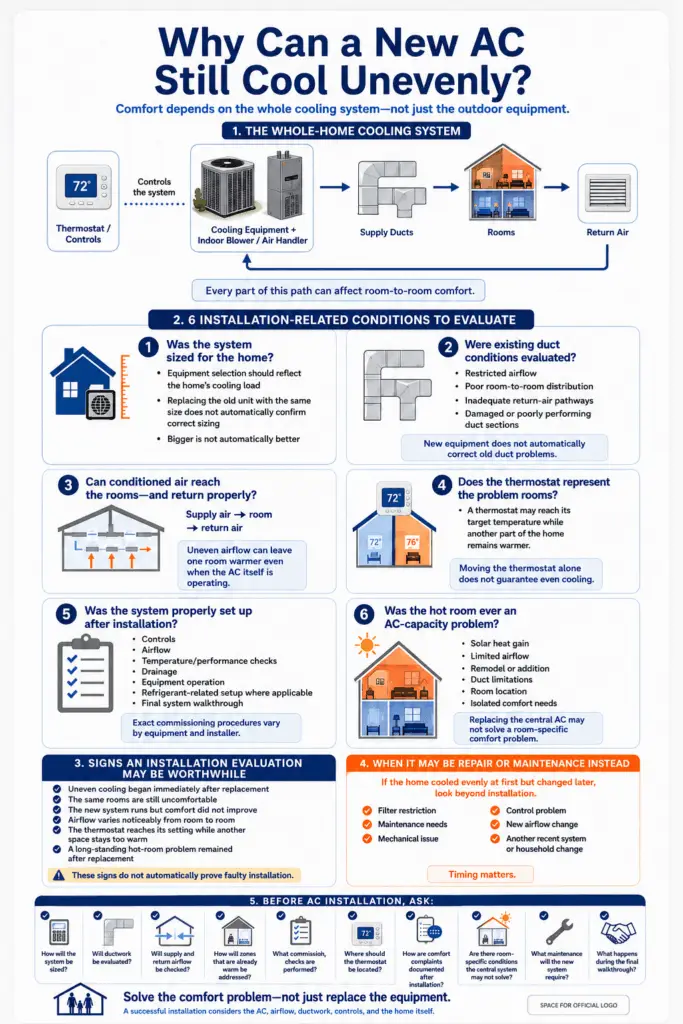
Signs the Problem May Be Installation-Related
Certain patterns may justify an installation and airflow evaluation, especially when they begin immediately after AC replacement.
Examples include:
- Uneven cooling began as soon as the new equipment was installed
- The same rooms remain uncomfortable after replacement
- The new system operates, but overall comfort did not improve
- Airflow differs noticeably between rooms
- The thermostat reaches its setting while another area remains too warm
- A long-standing comfort problem was expected to disappear after replacement but did not
These signs do not conclusively prove faulty installation.
They indicate that the equipment, sizing, airflow, ductwork, thermostat location, and installation setup may need to be evaluated together.
When the Problem May Be Repair or Maintenance Instead
Not every uneven-cooling complaint is an installation problem.
Timing matters.
If the system cooled the home evenly after installation but performance changed later, the cause may involve a newer maintenance or repair issue.
Possible areas to investigate include:
- Filter restriction
- Maintenance needs
- A mechanical problem
- A control issue
- A change in airflow
- Another recent system or household change
A homeowner can begin with an AC maintenance checklist that covers simple preventive checks such as inspecting the filter, confirming thermostat settings, and making sure supply and return vents are not blocked.
If there is now an active symptom—such as the AC not cooling, a sudden airflow loss, recurring ice, leaking, or failure to start—the better service path may be repair rather than routine maintenance.
See “AC Tune-Up or Repair? How to Tell What You Need” for help deciding which type of appointment fits the situation.
Questions to Ask an HVAC Contractor Before Installation
Homeowners can reduce the risk of carrying an old comfort problem into a new system by asking about more than equipment brand or model.
Before scheduling air conditioning installation in Downers Grove, IL, consider asking:
- How will the system be sized for my home?
- Will existing ductwork be evaluated?
- Will supply and return airflow be checked?
- How will rooms that are already too warm be addressed?
- What commissioning checks are performed after installation?
- Where should the thermostat be located?
- How are existing comfort complaints documented before work begins?
- Are there room-specific conditions the central system may not solve?
- What maintenance will the new equipment require?
- What should I expect during the final system walkthrough?
These questions help keep the discussion focused on actual comfort performance rather than treating replacement as a simple equipment swap.
Solve the Comfort Problem, Not Just Replace the Equipment
Uneven cooling after replacement does not always mean the home needs a larger air conditioner or another equipment change.
The right next step depends on whether the comfort problem has existed since installation or developed after the system previously cooled well.
Fire ’n’ Ice Heating & Cooling Inc. can evaluate the system and the home comfort concerns to determine the appropriate service path.
For ongoing comfort problems after replacement, schedule AC installation service in Downers Grove. A system that previously cooled well but has developed a new problem may need AC Repair instead.
The goal is to identify what is preventing the home from cooling comfortably and address the right part of the system.