

Repair may make sense when an AC problem is isolated and the system otherwise performs well. AC replacement becomes worth discussing when reliability, comfort, system condition, or recurring problems suggest that another repair may not solve the larger issue.
That decision becomes harder when you have already repaired the system before, the house still has comfort problems, or a technician has identified another issue that needs attention.
The goal is not to replace an air conditioner prematurely. It is to understand whether AC repair is likely to restore dependable performance or whether a broader replacement evaluation makes more sense.
AC Repair or AC Replacement? Start With the Whole System
No single symptom determines whether an air conditioner should be repaired or replaced.
A noisy component, weak airflow, uneven temperatures, or one service call does not automatically mean the entire system needs to be replaced. In the same way, fixing one failed part does not always address larger comfort, airflow, sizing, or installation concerns.
A qualified HVAC evaluation should consider several factors together, including:
- Repair history
- Current equipment condition
- Cooling performance
- Airflow
- Comfort throughout the home
- System configuration
- Installation quality
- Reliability expectations
The eight points below can help homeowners have a more useful conversation with an HVAC company before deciding what comes next.
8 Signs to Compare Before Deciding
1. How Reliable Has the AC Been?
Start with the system’s recent history.
Ask yourself:
- Is this the first significant problem?
- Have service calls become more frequent?
- Has the same issue returned more than once?
- Does the system usually operate normally between repairs?
An isolated repair on an otherwise dependable system is different from a pattern of recurring breakdowns.
There is no universal number of repairs that automatically means replacement is necessary. The type of problems, their frequency, the overall condition of the equipment, and the system’s performance all matter.
2. Is the Problem Isolated or Part of a Pattern?
Some air-conditioning problems may involve one repairable component while the rest of the system continues to perform normally.
Other situations may involve several concerns at once.
For example, a homeowner may report:
- Repeated service calls
- Weak airflow
- Uneven cooling
- Recurring ice
- Difficulty maintaining comfort
- New noises or operating changes
The more important question is not simply, “What part failed?”
It is, “Is this one isolated problem, or does it appear to be part of a larger pattern?”
A technician should evaluate that distinction before a homeowner assumes either repair or replacement is the right choice.
3. Is the AC Cooling the Home Evenly?
Comfort throughout the home matters when comparing repair and replacement options.
Pay attention to whether:
- Certain rooms consistently stay warmer
- Some areas receive much weaker airflow
- Temperature differences have become more noticeable
- Humidity or overall comfort has changed
- The system struggles to keep different parts of the home comfortable
Uneven cooling does not automatically mean the air conditioner needs to be replaced.
The cause may involve airflow, ductwork, system sizing, installation, building characteristics, or another issue that needs to be identified first.
If the problem has existed since the system was installed, the evaluation should look beyond the latest failed component.
4. Has Cooling Performance Changed Over Time?
A gradual change in performance can provide useful context.
You may notice that:
- Cooling cycles seem longer than they used to
- The home takes longer to reach the thermostat setting
- Comfort has slowly become less consistent
- The system does not seem to recover as well during hot weather
- Airflow or humidity control feels different
These changes do not prove that replacement is required.
They do, however, give the technician important information about how the system has been performing over time.
Rather than focusing on one day of extreme heat, compare current performance with what has been normal for your home and equipment.
5. Are Repairs Becoming More Frequent?
Repeated repairs deserve a broader conversation.
Avoid arbitrary rules such as “three repairs means replace.” That kind of formula ignores the condition of the equipment and the nature of the individual problems.
Instead, consider:
- What types of repairs have been needed?
- Are the same symptoms returning?
- How close together have service visits occurred?
- Does the system return to normal performance after repair?
- Are reliability concerns affecting your comfort or confidence in the equipment?
A technician can use that history alongside the system’s current condition to explain whether another air conditioning repair addresses the real problem or only one piece of it.
6. Is the System Properly Sized and Installed?
This is one of the most important factors to investigate when a system has never cooled the home properly.
If the air conditioner has struggled with comfort, airflow, or temperature balance since installation, repairing a failed component may restore operation without correcting the underlying design or installation issue.
A replacement evaluation may need to consider:
- Equipment sizing
- Home cooling load
- Ductwork
- Airflow
- Return-air capacity
- Supply distribution
- Thermostat location and controls
- Existing equipment configuration
Replacing equipment without understanding those conditions can leave the homeowner with the same comfort complaint.
This is why a good AC installation consultation should evaluate the home and system, not simply swap one unit for another.
7. Are Parts and Service Options Still Practical?
Equipment considerations can change as systems age, but broad assumptions should be avoided.
A technician may need to evaluate factors such as:
- Availability of appropriate replacement components
- Manufacturer support
- Compatibility with the existing system
- Current equipment condition
- Service options for the specific model
Avoid assuming a system is obsolete simply because it is older. The decision should be based on the actual equipment and available service options.
8. What Does an AC Replacement Evaluation Find?
The final decision should be based on what the system and home actually need.
A full evaluation may consider:
- Overall equipment condition
- Cooling performance
- Airflow
- System configuration
- Existing comfort complaints
- Repair history
- Installation concerns
- Equipment compatibility
- Home characteristics
This is where professional judgment matters most.
A homeowner may begin the appointment expecting another repair and learn that broader system concerns are present. Another homeowner may worry that replacement is necessary and find that an isolated repair can restore normal operation.
The evaluation should help clarify those differences.
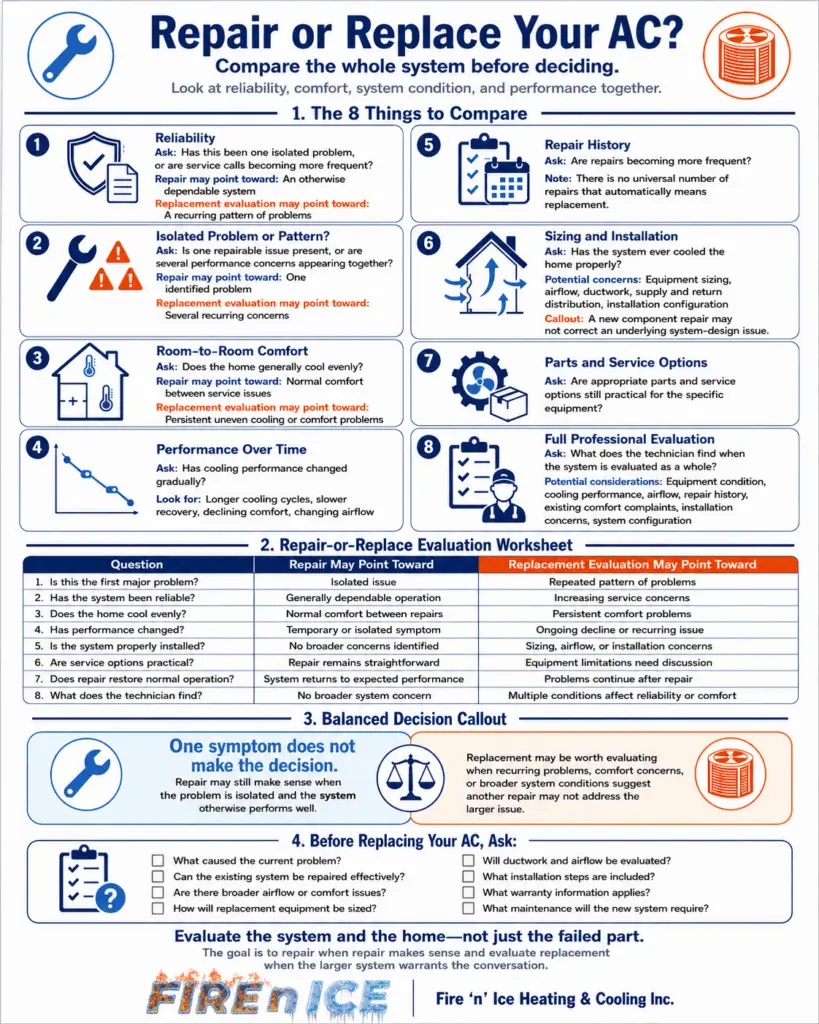
Repair-or-Replace Evaluation Worksheet
A simple comparison can help organize the conversation.
| Question | Repair May Point Toward | Replacement Evaluation May Point Toward |
|---|---|---|
| Is this the first major problem? | Isolated issue | Repeated pattern of problems |
| Has the system been reliable? | Generally dependable operation | Increasing service concerns |
| Does the home cool evenly? | Normal comfort between repairs | Persistent comfort problems |
| Has performance changed? | Temporary or isolated symptom | Ongoing decline or recurring issue |
| Is the system properly installed? | No broader concerns identified | Sizing, airflow, or installation concerns |
| Are service options practical? | Repair remains straightforward | Equipment limitations need discussion |
| Does repair restore normal operation? | System returns to expected performance | Problems continue after repair |
| What does the technician find? | No broader system concern | Multiple conditions affect reliability or comfort |
When AC Repair May Still Make Sense
Repair may still make sense when the problem is isolated, the system otherwise cools the home reliably, and the technician does not identify broader airflow, installation, or equipment concerns. The goal is to determine whether repairing the identified problem is likely to restore normal operation—not to replace equipment simply because it needs service.
When AC Replacement Is Worth Discussing
AC replacement may be worth evaluating when recurring problems, reliability concerns, persistent comfort issues, or broader system conditions suggest that another repair may not address the larger problem. Replacement is not automatic; it becomes an option to evaluate alongside the condition of the existing system and the needs of the home.
What Should a Replacement Evaluation Include?
A good replacement consultation should do more than identify a new piece of equipment.
Before recommending an air conditioning replacement in Downers Grove, IL, the HVAC company should understand how the current system performs and what the homeowner wants to improve.
Potential evaluation areas include:
- Existing comfort complaints
- Home size and characteristics
- Equipment sizing or load assessment
- Ductwork and airflow
- Current system configuration
- Thermostat and control needs
- Installation requirements
- Equipment options
- Manufacturer guidance
- Applicable warranty information
Understanding what the evaluation covers can also help you ask better questions before deciding whether replacement is the right next step.
Questions to Ask Before Replacing Your AC
Homeowners do not need to know every technical detail before an AC installation consultation.
A few practical questions can make the discussion more useful:
- What caused the current problem?
- Can the existing system be repaired effectively?
- Are there broader airflow or comfort issues?
- Is the current system properly sized for the home?
- How will replacement equipment be sized?
- Will the duct system and airflow be evaluated?
- Are there installation conditions that need to be corrected?
- What steps are included in the installation?
- What manufacturer warranty information applies?
- What maintenance will the new system require?
These questions help shift the conversation away from “new unit versus old unit” and toward the quality of the entire cooling system.
Get an Evaluation Before Deciding
Choosing between repair and replacement should be based on the condition of the equipment, its repair history, comfort throughout the home, airflow, installation quality, and what a technician finds during the evaluation.
Fire ’n’ Ice Heating & Cooling Inc. can inspect the existing system and help determine whether AC repair in Downers Grove is appropriate or whether the home’s comfort and equipment needs warrant an AC installation evaluation.
The goal is to make the decision based on the system and home as a whole—not simply the latest failed part.