
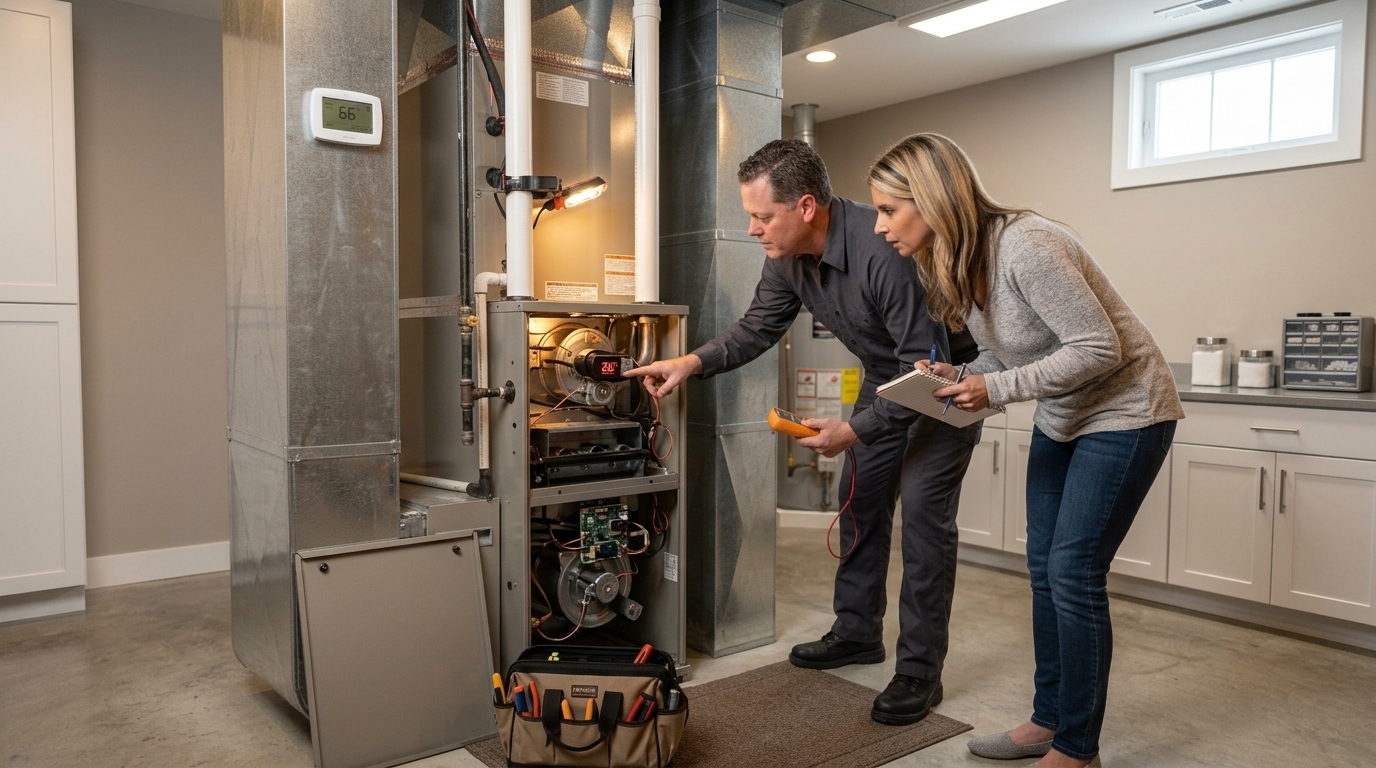
If your furnace is not working, start with a few simple safe checks that do not require opening the equipment or attempting a repair. Confirm the thermostat is calling for heat, look at the filter, make sure vents and returns are clear, and check whether the system appears to have normal power.
The goal is not to teach DIY furnace repair. It is to help you observe what the system is doing, rule out a few basic conditions, and know when it is time to call a technician.
Fire ’n’ Ice Heating & Cooling Inc. provides heating repair and maintenance services in Downers Grove and surrounding areas.
Furnace Not Working? Start With These Safe Checks
Check the Thermostat
Start with the thermostat before assuming the furnace itself has failed.
Confirm that:
- the thermostat is set to heating mode;
- the requested temperature is above the current room temperature;
- the display appears normal;
- the schedule or program is not overriding the setting; and
- batteries are not depleted, if the thermostat uses replaceable batteries.
Then note what happens.
Does the furnace respond at all? Does the blower start? Does the thermostat indicate that heat is on even though nothing happens?
If the thermostat itself seems to be the problem, review Thermostat Not Working? 7 Checks Before Heating Season before moving deeper into furnace troubleshooting.
Check the Air Filter
If the filter is safely accessible, inspect it for obvious buildup and confirm that it is installed correctly.
A heavily restricted filter can affect airflow and, depending on the system, may contribute to operating problems. Replacing a dirty filter can be appropriate maintenance, but it should not be treated as a guaranteed fix for every furnace problem.
If the furnace still does not operate normally after the filter has been checked, the cause may be elsewhere in the system.
Make Sure Vents and Returns Are Open and Clear
Walk through the home and check for obvious airflow obstructions.
Look for:
- furniture covering return-air openings;
- closed or blocked supply registers;
- rugs or boxes covering vents; or
- storage placed directly in front of return grilles.
Remove obvious household obstructions, but do not change ductwork, adjust internal dampers, or attempt to rebalance the HVAC system yourself.
Check for an Obvious Power Interruption
If the furnace appears completely unresponsive, look only for simple, visible power conditions that are appropriate for a homeowner to observe.
For example, you may be able to confirm whether:
- the thermostat display is on;
- the furnace appears to have normal household power; or
- another obvious interruption occurred at the same time.
Do not repeatedly reset breakers, open electrical cabinets, bypass switches, or jump wires.
If an electrical problem is suspected, stop troubleshooting and arrange professional evaluation.
Look for an Error Code or Indicator
Some furnaces provide an accessible fault light, code, or display when something interrupts operation.
If you can see an indicator without removing service panels:
- write down the code;
- take a photo if helpful;
- check the manufacturer documentation; and
- share the information with the technician when scheduling service.
Do not enter service menus or remove panels to search for a code.
An error code can help describe what the system detected, but it does not always tell a homeowner what repair is required.
Listen to What Happens When the Furnace Tries to Start
What you hear can help describe the problem even if it cannot identify the failed component.
Notice whether:
- nothing happens;
- you hear clicking;
- the blower starts;
- the system starts and then stops;
- airflow begins but does not feel warm; or
- the furnace appears to repeat the same startup attempt.
These observations are more useful than trying to diagnose the part yourself.
If you later call for furnace repair, tell the technician what happens from the moment the thermostat calls for heat.

When to Stop Troubleshooting the Furnace
Basic homeowner checks should stop when the problem involves a possible safety concern.
Do not continue troubleshooting the furnace if you notice:
- a suspected fuel-gas odor;
- smoke;
- a persistent burning or electrical smell;
- a carbon-monoxide alarm;
- repeated electrical problems;
- visible damaged wiring; or
- another abnormal condition that may involve combustion or electrical safety.
| ! |
Safety Alert Do not continue operating or troubleshooting equipment when a possible gas, carbon-monoxide, fire, or electrical hazard is present. Follow the emergency or safety instructions provided by the appropriate utility, alarm manufacturer, equipment manufacturer, or local emergency authority for the condition involved. |
Fire ’n’ Ice provides 24/7 emergency heating repair service, but a heating contractor’s blog should not replace emergency instructions from the appropriate safety authority.
Why a Furnace May Stop Working
A furnace that will not start, shuts down unexpectedly, or produces no useful heat can have more than one possible cause.
The symptom alone usually does not identify the failed component. A technician may need to evaluate several areas before determining the repair.
Thermostat or Control Problem
A thermostat, control setting, or related control issue may prevent the heating system from operating as expected.
A technician may evaluate whether the thermostat is communicating properly with the equipment and whether the relevant controls are responding correctly.
This is one reason a thermostat problem can look like a furnace problem from inside the house.
Airflow or Filter-Related Condition
Restricted airflow can affect how a furnace operates.
A technician may look at filter condition, blower operation, return-air conditions, supply airflow, and other parts of the distribution system if airflow appears to be part of the problem.
A new filter may help when the existing one is heavily restricted, but airflow problems can also have other causes.
Electrical or Ignition-System Issue
A furnace may fail to start or stay running because of an electrical or ignition-related condition.
The exact cause depends on the equipment.
A technician may evaluate the system’s controls, electrical components, startup sequence, and ignition-related components rather than assuming one particular part has failed.
Safety Control or Equipment Lockout
Modern heating equipment may stop operating when a control detects a condition that needs attention.
If the system enters a fault or lockout condition, a visible error code or indicator may help the technician understand what happened.
Do not bypass a safety control to force the furnace to run.
Mechanical Component Problem
Motors, blowers, controls, and other moving or operating components can develop problems over time.
Symptoms may include:
- unusual noise;
- weak or missing airflow;
- intermittent operation; or
- failure to complete the heating cycle.
A technician may need to inspect the equipment before identifying which component is involved.
Fuel or Combustion-Related Issue, Where Applicable
Fuel-burning furnaces also depend on proper fuel delivery, ignition, venting, and combustion-related operation.
Those areas should not be treated as DIY troubleshooting tasks.
If the problem appears to involve fuel, combustion, or another safety-sensitive condition, professional evaluation is appropriate.
What Should You Tell the Furnace Repair Technician?
A clear description of what the furnace is doing can make the service call more useful.
Before scheduling furnace repair, note:
- What does the thermostat display?
- Does the furnace make any sound?
- Does the blower operate?
- Is the airflow warm, cool, or absent?
- Did the problem begin suddenly or gradually?
- Is there an error code or indicator?
- Did you notice an unusual odor?
- Was there a recent furnace repair or tune-up?
- Is the problem constant or intermittent?
- Does the furnace start and then stop?
You do not need to diagnose the furnace before calling.
The goal is simply to give the technician a clearer starting point.
Tune-Up or Repair: Which Service Do You Need?
A furnace tune up is preventive maintenance for a system that is generally operating. If the furnace has an active heating problem that remains after the basic checks, heating repair is the more appropriate service.
For seasonal maintenance, use our Furnace Tune-Up Checklist Before the First Freeze. If you’re weighing another repair against replacement, see When to Replace a Furnace Instead of Repair It.